Traveling with a baby is one of the most exciting — and nerve-wracking — things a parent can do. Between packing diapers, figuring out feeding schedules, and navigating airport security with a stroller, the last thing you want to worry about is whether your little one is sleeping safely in the next room. That’s exactly why finding the best baby monitor for travel is not just a nice-to-have — it’s an absolute must for any traveling parent.
Whether you’re staying at a hotel, crashing at grandma’s house, or spending a week in an Airbnb rental, having a reliable portable baby monitor gives you the freedom to step away without the constant anxiety. In this guide, I’m sharing everything I’ve learned through my own experience as a mom who has traveled extensively with two kids under three — from the features that truly matter to the specific monitors I trust most.
Table of Contents
Why I Needed a Baby Monitor for Travel (A Mom’s Perspective)
It started with a road trip to visit my in-laws during the holidays. Our youngest was about seven months old, and the sleeping arrangements meant she’d be in the guest bedroom while my husband and I sat in the living room — two walls and a hallway away. I realized I had nothing. No monitor, no way to hear her, and absolutely no way to see her.
I ended up sitting on the cold hallway floor with the guest room door cracked open, straining to hear every sound. Not exactly the relaxing family visit I had imagined. That experience changed everything. From that trip forward, I researched, tested, and eventually found monitors that genuinely work in real-world travel situations.
The Pain Points Every Traveling Mom Knows
Here are the exact problems I ran into — and I know I’m not alone:
- No built-in camera available at the destination (most hotels and rentals don’t have baby monitoring equipment)
- Unstable or password-locked WiFi at hotels, which makes app-based monitors nearly useless
- Different room layouts than at home — you can’t always hear your baby from the common area
- Limited outlet availability for charging multiple devices while traveling
- Security concerns about using unfamiliar networks or smart devices in shared spaces
“Peace of mind is everything when you’re traveling with a baby. Once I found the right monitor, I could actually enjoy the trip instead of spending every moment anxious.”
If any of that resonates with you, you’re in exactly the right place. Let me walk you through everything you need to know.
What to Look for in the Best Baby Monitor for Travel
After testing multiple monitors across hotels, cabins, family homes, and Airbnbs, I’ve narrowed down the features that genuinely matter when you’re on the road. Here’s what to prioritize:
Portability and Compact Design
When you’re already juggling a stroller, a carry-on, and a diaper bag the size of a small car, your baby monitor cannot be another bulky item to haul around. The best travel baby monitors are small, lightweight, and easy to set up without tools or complicated instructions.
Look for monitors that fold flat, come with a compact carrying case, or weigh under one pound. Ideally, it should fit comfortably in your personal bag. Setup should take no more than a minute — just plug in and go.
Battery Life — A Must-Have for Travel
This is non-negotiable. At home, you can keep your monitor plugged in. On the road, outlets are limited and inconveniently placed. A travel baby monitor needs a battery life of at least 8 to 12 hours, ideally more. Even better if it supports charging via a standard USB cable or power bank.
I once had a WiFi-based monitor die at 2 AM in a hotel room because I couldn’t find a convenient outlet near the camera position. That taught me to always check battery specs before buying.
WiFi vs. Non-WiFi Baby Monitors for Travel
This is the biggest decision you’ll make when choosing a travel monitor, and the answer depends entirely on where and how you travel.
WiFi monitors connect to your home network or a hotel’s WiFi and allow you to view the camera feed through a smartphone app — even from the hotel lobby or poolside. They’re incredibly convenient when the connection is solid. But in my experience, hotel WiFi is notoriously unreliable, slow, or locked behind network restrictions that prevent smart devices from connecting.
Non-WiFi monitors use a dedicated radio frequency between the camera unit and a parent receiver. No internet required. No apps. No passwords. They work instantly, regardless of your location. For most travel scenarios, I actually prefer these for their rock-solid reliability.
Night Vision and Audio Quality
Babies sleep a lot — and the most critical moments to check on them are in the dark. Any monitor worth considering for travel must have clear infrared night vision so you can see your baby without turning on a light and disturbing them.
Two-way audio is also a significant bonus. Being able to softly whisper a soothing word to your baby from another room without physically going in can be a game-changer, especially in unfamiliar sleeping environments where babies tend to stir more often.
Safety and Privacy — Important for Every Mom
If you choose a WiFi-connected monitor, please pay close attention to security features. Baby monitors have unfortunately been targeted by hackers in the past. Always choose brands with end-to-end encryption, automatic firmware updates, and strong password protection.
Non-WiFi monitors sidestep these concerns almost entirely, since they don’t transmit data over the internet. If privacy is a major concern — especially when using hotel or public WiFi networks — a non-WiFi model is the safer choice.
Best Baby Monitors for Travel — Mom-Approved Picks
These are the monitors I’ve personally used or rigorously researched through parent communities, verified review platforms, and direct testing during trips with my own children.
Best Overall Travel Baby Monitor — Infant Optics DXR-8 Pro
The Infant Optics DXR-8 Pro consistently earns its place at the top of almost every serious baby monitor list — and for good reason. It’s a non-WiFi monitor with a dedicated parent unit, interchangeable lens system, and outstanding battery life. The parent unit lasts up to 10 hours in power-saving mode, which covers a full night of travel.
What I love most about it for travel is the interchangeable lens option. The wide-angle lens covers an entire hotel room without repositioning. The video quality in night mode is clear enough to see the rise and fall of your baby’s chest — something that genuinely calms a nervous parent.
- Pros: Stable non-WiFi signal, long battery life, excellent night vision, modular lens system
- Cons: Slightly pricier than entry-level monitors, no smartphone app
- My experience: Used this across three hotel stays and a week-long family cabin trip. Never lost signal, never drained unexpectedly.
Best Budget Option — HelloBaby HB65
Not every family wants to spend top dollar on a travel monitor, and the HelloBaby HB65 proves you don’t have to. For a fraction of the cost of premium monitors, it delivers solid video quality, a reliable non-WiFi connection, and a parent unit with approximately 6 to 8 hours of battery life.
It’s a great entry point for occasional travelers. The setup is about as simple as it gets: plug in the camera, turn on the receiver, and you’re done. If you travel once or twice a year and need a dependable lightweight baby monitor that won’t break the bank, this is worth serious consideration.
Best Portable and Compact Monitor — Eufy SpaceView S
If airline travel is part of your routine, the Eufy SpaceView S is a dream. The entire unit — camera, receiver, and cords — fits into a space smaller than most books. The camera is lightweight enough to clip onto a headboard or prop on a nightstand without risk of tipping.
Battery life on the parent unit reaches up to 12 hours, and the 720p video quality is clear and smooth. For parents who fly frequently or who pack ultra-light, this is the best portable baby monitor currently available in its price range.
Best Non-WiFi Baby Monitor for Travel — VTech DM221
For families heading somewhere remote — a mountain cabin, a beachside rental without strong internet, or a rural family home — the VTech DM221 is a trusted, no-frills audio monitor that simply works. No camera, but the DECT 6.0 digital technology delivers crystal-clear audio with virtually zero interference.
It’s incredibly lightweight, the parent unit clips to a belt or pocket, and the range covers most standard properties comfortably. If you want a travel baby monitor that requires absolutely no WiFi and no setup beyond plugging it in, this remains one of the best options at any price.
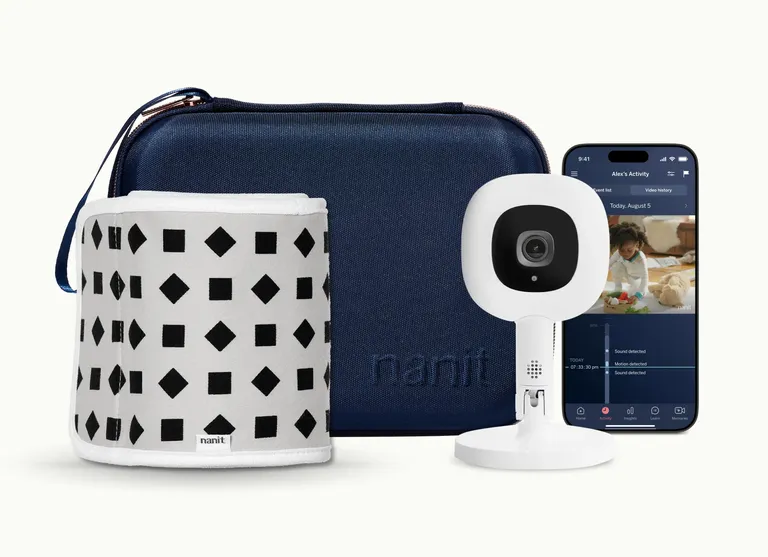
Best WiFi Baby Monitor for Travel — Nanit Pro
For families who frequently stay in rentals or locations with reliable, high-speed WiFi — and who value remote viewing from a smartphone — the Nanit Pro is the gold standard. The camera quality is exceptional, the app is intuitive, and it includes features like sleep tracking and breathing band monitoring that are hard to find elsewhere.
The caveat, as I’ve mentioned, is total dependence on a strong internet connection. When it works, it’s magical — you can check on your baby from the hotel pool or a restaurant nearby. When it doesn’t work (and at some hotels, it won’t), you’re left without a functioning monitor. Always have a backup plan.
My Real Experience Using a Baby Monitor While Traveling
Let me paint a picture for you. We were staying in an Airbnb on the Florida coast — a two-bedroom place where our daughter’s room was at the opposite end of a long hallway from the living area. We’d put her down around 7:30 PM, which meant we had a few hours to enjoy the evening without waking her.
With the Infant Optics DXR-8 Pro set up on the dresser across from her crib (well, the travel crib we brought), I could sit on the back patio with my husband and watch the monitor from the parent unit. When she stirred around 9 PM, I saw it immediately on the screen, went in quietly, adjusted her blanket, and she went straight back to sleep.
Without a monitor, I would have been back and forth checking on her manually every 20 minutes, unable to relax or truly enjoy the trip. With it, I had my eyes on her and my mind at ease.
The lesson I took from that trip and others like it: a dedicated non-WiFi monitor with a parent unit is almost always more reliable than a WiFi-based solution in unfamiliar locations. Hotel networks, guest WiFi passwords, and unstable connections are just too unpredictable.
WiFi vs. Non-WiFi Baby Monitors for Travel — Which Is Better?
I get asked this question constantly by other moms in my parent groups. Here’s the honest breakdown:
| Feature | WiFi Monitor | Non-WiFi Monitor |
| Setup | Requires stable network connection | Plug & play — ready in seconds |
| Stability | Depends on hotel/venue WiFi quality | Extremely stable, no signal drops |
| Remote Access | View from anywhere via app | Limited to dedicated receiver range |
| Security | Cloud/app risks if unsecured | No internet exposure — safer |
| Battery Life | Varies by device | Often longer — no WiFi drain |
| Best For | Families in rentals with good WiFi | Camping, remote cabins, rural areas |
My personal take after years of traveling with babies:
“I personally prefer non-WiFi monitors when traveling because hotel networks are unpredictable and I can’t afford a dropped connection when my baby is sleeping in another room. At home, or in a rental with a dedicated strong network, a WiFi monitor like the Nanit Pro is wonderful. On the road? I trust the dedicated receiver every time.”
That said, every family’s travel style is different. If you consistently stay in modern vacation rentals with excellent WiFi, and you love the convenience of viewing the feed on your phone, a WiFi monitor makes total sense. If you’re more of a mixed-itinerary traveler — hotels, family homes, camping, cabins — a non-WiFi model will serve you better.
Tips for Traveling with a Baby Monitor
After many trips and a few hard lessons, here’s what I tell every parent before they travel:
- Bring the right power adapter — if you’re traveling internationally, your monitor’s plug may not match the local outlet standard. A universal travel adapter is essential.
- Test everything before you leave home — set up the monitor in a different room from the receiver and confirm the signal, battery life, and night vision work as expected.
- Position the camera strategically — find a spot with a clear view of your baby’s sleeping area, ideally elevated slightly, angled down. Never place it within reach of the baby.
- Carry a backup — even if you have a great video monitor, pack a small audio-only monitor or use your phone with a basic baby monitor app as an emergency backup.
- Charge everything the night before you depart — and keep a charging cable accessible in your bag throughout the trip.
- If using WiFi, request the hotel’s dedicated device network — some hotels have separate networks for smart devices that are more stable than the general guest WiFi.
Common Mistakes Moms Make When Choosing a Travel Baby Monitor
I made most of these mistakes myself before I knew better. Learn from my experience:
Choosing a Monitor That’s Too Bulky
Some of the best home baby monitors are simply not designed for travel. Large base stations, multiple cords, and heavy camera units that require mounting are fine at home but become frustrating liabilities on the road. Always check the dimensions and total weight of the full kit before purchasing a monitor you intend to travel with.
Relying Entirely on Hotel WiFi
I cannot stress this enough: hotel WiFi is notoriously unreliable for smart devices. Many hotel networks use client isolation (which prevents devices on the same network from communicating with each other), outdated infrastructure, or aggressive bandwidth throttling. Do not assume your WiFi monitor will simply connect and work at every hotel.
Skipping the Battery Life Check
A monitor that dies at 3 AM because you couldn’t find a convenient outlet is worse than no monitor at all — because you thought you were covered. Always verify the rated battery life and consider how you’ll charge the unit during travel.
Ignoring Range Limitations
Some monitors have impressive range in open areas but struggle through multiple walls. Hotels and rental properties often have thick concrete or brick walls that significantly reduce signal range. If possible, choose a monitor rated for at least 300 to 500 feet of indoor range.
How to Choose the Right Baby Monitor for Your Family
There’s no single “best” travel baby monitor for every parent. The right choice depends on your specific travel habits and priorities:
- How often you travel: If you’re a frequent traveler — multiple trips per year — invest in a high-quality, durable monitor. If you travel occasionally, a budget-friendly option will serve you fine.
- Your typical destinations: Consistent vacation rental traveler with strong WiFi? A smart WiFi monitor is a great fit. Hotel-hopper or rural destination traveler? Go non-WiFi, every time.
- Your budget: Entry-level non-WiFi monitors start around $30 to $50 and perform reliably. Mid-range options with better video quality and features sit in the $80 to $150 range. Premium WiFi models with advanced features can reach $200 to $300.
- Your need for features: Basic audio monitoring, video monitoring, two-way talk, temperature sensing, sleep analytics — decide which features genuinely matter to you and filter accordingly.
FAQs About Baby Monitors for Travel
Do I really need a baby monitor for travel?
If your baby sleeps in a separate room from you — even temporarily — yes, absolutely. In unfamiliar environments, babies tend to stir more, wake more frequently, and potentially get into unexpected situations. A monitor lets you respond quickly without being in the room with them 24/7.
Can I use my phone as a baby monitor?
In a pinch, yes. Apps like Baby Monitor 3G or Alfred can turn two smartphones into a basic monitoring system. But this relies on both phones having a stable internet connection, keeping both screens active, and draining both batteries simultaneously. It works as an emergency backup, but I wouldn’t rely on it as a primary solution.
Are WiFi baby monitors safe to use in hotels?
This depends on the monitor’s security features. Look for end-to-end encryption, secure authentication, and regular firmware updates. Even with these protections, hotel networks are public-facing and carry inherent risks. If you have privacy concerns, a non-WiFi monitor is always the safer option in hotel environments.
What is the best baby monitor for international travel?
For international travel, a non-WiFi monitor with universal voltage compatibility (100-240V) and a compact form factor is ideal. The Infant Optics DXR-8 Pro and the Eufy SpaceView S both handle international travel well. Just remember to pack the appropriate power adapter for your destination country.
Final Thoughts — From One Mom to Another
Traveling with a baby is hard work. It demands planning, patience, and more packing lists than you ever imagined. But it’s also some of the most memorable, beautiful time you’ll spend together as a family. And the more confident and prepared you feel, the more you can actually be present for those moments.
A great travel baby monitor won’t make the trip perfect. But it will give you something priceless: the ability to breathe, relax, and trust that you’ll know the moment your little one needs you — whether you’re in the next room or on the hotel balcony watching the sunset.